
FETCHDOKU GUIDES
How to solve Queens‑style logic puzzles
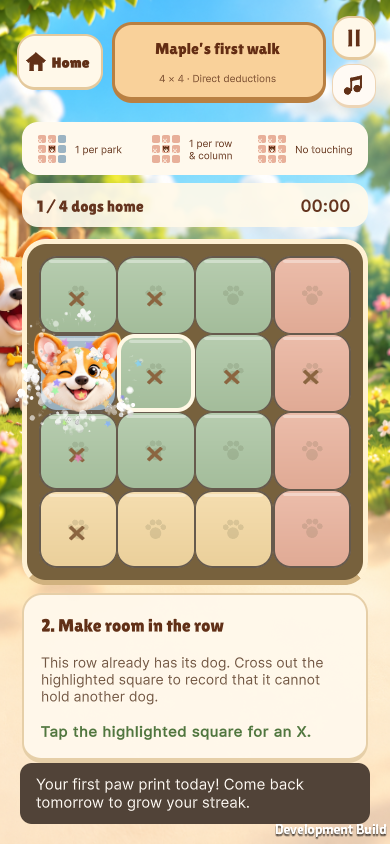
Some puzzles ask you to place exactly one piece in every row, every column and every coloured region, with no two pieces touching, even diagonally. If you have played Queens, Star Battle (the one-star version) or Fetchdoku, you know the type. They can look hard and are very solvable with a few repeatable moves.
Spot a park in one row
Park 1 fills the top row. Its dog must be in that row, so no other park can place a dog there. This solved example also shows the no-touch rule.
Illustrative puzzle · Numbers identify parksKnow the constraints
For an N×N grid you place N pieces. Each row, column and region holds exactly one, and no two touch, even at a corner. Because every region needs exactly one piece, a region is as important as a row.
Move 1: Start with the smallest region
A region with one square is solved at once. Place the piece, then cross out its whole row, its whole column and the eight squares around it. A region with two squares leaves just two possibilities, which is an excellent place to look next.
Move 2: A region inside one line
If every square of a region sits in a single row, that row's piece has to belong to that region. Cross out every square in that row that belongs to a different region. The same works for columns.
Move 3: Several regions inside the same lines
This is Move 2 with a bigger group. If two regions are entirely contained within the same two rows, those two rows are used up by those two regions. Everything else in those rows can be crossed out. In general, if k regions fit inside exactly k rows (or columns), those rows belong to them.
Move 4: Squares that touch every option
Suppose a region has only a few squares left and some other square touches all of them. A piece there would make it impossible for the region to place its piece, so that square can be crossed out. Small clusters (a region shaped like a short line or an L) often give you this.
Move 5: Count, don't guess
Count how many regions are completely inside a set of rows or columns, and compare with how many rows or columns there are. If a set of lines has more room than the regions inside it need, the rest of the squares in those lines must be filled by pieces from regions that reach outside them.
When you're stuck: try one assumption
Pick a square in a tiny region and imagine a piece there. Follow the consequences with Moves 1 to 4. If that leads to a contradiction (a row or region with nowhere left to go), the square gets crossed out. Use this sparingly: most puzzles are solvable without it, and it is slower than spotting the patterns above.
Practise on small grids
Fetchdoku starts small and builds up, with guided practice from Maple the corgi, so the moves above become second nature. Download it free on iPhone and iPad or Android. New to it? Start with how to play Fetchdoku.
Put your new tricks to work
Meet your pack and try the puzzles in Fetchdoku. Start playing free on iPhone, iPad or Android.