
FETCHDOKU GUIDES
Logic puzzle tips for beginners
Logic puzzles are not about being clever in a flash. They are about being tidy: writing down what you know and letting it do the work. These habits help with almost every grid puzzle.
Mark what one dog rules out
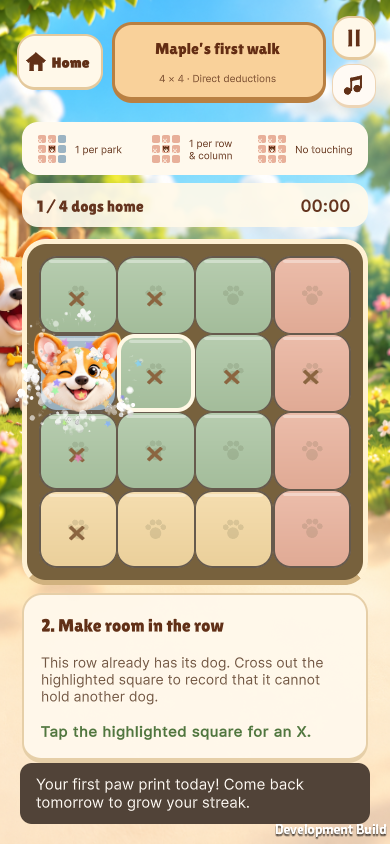
The dog in row 1, column 2 rules out the rest of its row and column, plus every neighbouring square. Crosses show those exclusions; blank squares are still undecided.
Illustrative puzzle · Numbers identify parks1. Write down what you know
Cross out squares the moment you know they can't be right. In a grid puzzle the crosses are the thinking. Each one removes options and makes the next step visible.
2. Start where there are fewest choices
The smallest region, the nearly full row, the square with one possible answer. Constrained spots give you certainty for free.
3. Ask "where could this go?"
Instead of asking what a square should hold, ask where a given item can go. Often a region has only one place left even when no single square looks obvious.
4. Look at lines, not squares
When a group of squares all sit in one row or column, that line is claimed. This one idea solves a surprising number of puzzles.
5. Guess last, and test it
If you must guess, treat it as an experiment: assume one thing, follow the consequences, and drop it as soon as you hit a contradiction. A guess you cannot disprove is not a result.
6. Take a break
A fresh look often shows what you missed. Short, regular play beats a long, frustrating session. That is why Fetchdoku is built around short daily walks.
Practise somewhere friendly
Start with how to play Fetchdoku, or read the full method for one-per-row puzzles.
Put your new tricks to work
Meet your pack and try the puzzles in Fetchdoku. Start playing free on iPhone, iPad or Android.